

Louis Pereira

I live a dual life. During the day I work with my family to run a traditional business in Goa, India. At night, I build assets on the internet.

Products I've built

Writing

Crony capitalism works if a country has something of value to offer the world. Oil. Rare earth minerals. Tourist destinations. Cheap labour. Manufacturing. BPOs.

It can also work for a while if a country is an effective bully.

But it cannot work if a country has nothing much to offer, and is not powerful enough to be a bully.


Capitalism is beautiful because it creates conditions for innovation, by letting innovators and investors play the risk/reward game.

Most attempts fail, but the few that succeed, do so spectacularly. This lets the game go on.

Taxes from an occasional big victory keep the entire country afloat. Each victory creates hope in the minds of the game's spectators, and converts some of them into players in the next round. The cycle goes on.


But if the game is rigged in favor of the ruler's friends, other innovators stop playing. They migrate.

Investors stop investing, because outsized returns are not easy to create, unless you have local connections.

For as long as the master's favored players are able to create something the world wants, the status quo persists. But eventually, softened by the lack of competition, these players will fail. They will become slower. Less ambitious. More protective of their positions.

Then, the country will be in trouble.

The only way out will be for it to convince its citizens to start playing the risk/reward game of innovation again. To promise them that there will be a reset, and the rules will apply equally to everyone once from then on.

That however, is easier said than done.

Trust, destroyed in a single government term, can take decades to rebuild.
Intuition is subconscious pattern matching. When your gut tells you something feels right, it's often smart to listen, even if you can't rationalise your reasoning.

However, there are situations where listening to your gut is a dumb idea.

Here are a few rules I try to follow, although I usually fail:

(1) Don't rely solely on your intuition when a decision's worst case outcome  is one you cannot bear. The purpose of most games is to keep playing, even if you lose.

(2) If the nature of a field hasn't changed in decades (relationships, diets, fitness, etc.), follow the advice of people who have vastly more experience than you, even if it clashes with your intuition.

(3) Don't trust your intuition when you have a strong preference for a particular outcome. You will tend to make bad decisions that are influenced by what you want, not what is right.

(4) Evolution only cares about you surviving for long enough to reproduce. When your goals clash with those of evolution, don't trust your intuition. It is likely being tricked by forces beyond your control (aka evolution's best weapons: emotions).

Flashes of creativity appear in the blank spaces on my calendar. In the shower. On a walk. While driving. They seem to bubble up from my subconscious without any prodding. And the more I look for them, the less they appear.

They usually aren't original thoughts. Instead, they're mixtures of ideas from elsewhere. Original only insofar as their combination. Beauty at intersections.

These creative flashes seem to arrive effortlessly, but in reality, they are delayed rewards for intense conscious effort. Deferred compensation for hours of seemingly fruitless focus on a topic I'm seeking to understand. The more I struggle, the more I am rewarded.

This direct correlation between conscious effort and subconscious reward is an exponential relationship. The best results come from consistently focusing on one thing for extended periods of time. And half the effort produces much less than half the results.

Unfortunately, this means that for my best, most creative work to emerge from my subconscious, I must let my conscious mind be completely consumed by a single topic.

And for my multitasking, overstretched, shiny object syndrome affected self, that is a challenge I must learn to overcome.

Outside of work and family time, I have about five free hours each day to build my side projects, learn new skills, practise old ones, and enjoy my hobbies.

I wish I had more, but as someone who doesn't have kids yet, I'll take it. 5 hours is plenty.

But I've been trying to figure out how to spend those 5 hours. I'm not Elon, so I can't tackle everything. I must pick and choose.


This morning, I was immersed in a book. I didn't want to stop. Why couldn't I spend 3 hours reading instead of reading for 30 minutes and then moving onto something else? Wouldn't the intensity be better?

The same question applies to writing, coding, and my side projects: Should I focus on short daily sessions (consistency), or on all-out sprints until the work is done (intensity)?


The answer dawned on me at dusk today.

Consistency works for tasks where it's easy to get back into the zone after a break.

But for tasks that takes time to sink into, only intensity will do. Even if it means sacrificing something else.

16g of coffee ground at a setting of 1/30. 240g of water heated to 95 degrees. Bloom the coffee with 30g of water and leave it for 35 seconds. Then pour the remaining 210g of water in slow concentric circles.

That's my daily routine to prepare my first cup of coffee upon waking. As long as I stick to light or medium roast beans, consistency is guaranteed. The process of brewing started as an art, devoid of sensitive measuring scales, precision steel burr grinders, and temperature controlled kettles. But today, it's a science, and I'm the mad scientist.

Consistency works well at scale, where repeatability is of prime importance. In a factory, for instance. But at home? Wouldn't we be better off with a little more accidental variety?

I don't know what the point is here, and I'm not even sure if coffee is the right example, but I do know that there exists a certain beauty in variability, and that beauty doesn't get its due. Random mutations are how we have evolved, and maybe we have to keep some room for them in our ever precise lives.

Else, we will be sacrificing global maxima for the feeling of local precision.

Advice from successful media creators must be taken with a pinch of salt.

"Start writing online".
"Start a podcast".
"Start a YouTube channel".

Okay, but hold on. Imagine two scenarios:

1. An online writer making a $500K a year
2. An investor making $5 million a year

Both love what they do equally. Both work the same number of hours each week. Which of the two would you rather be? And which of the two would you be more likely to hear from?

Advice (or 'gyaan' as I call it) from successful media creators is more likely to reach us because they're dispensing it on home turf. They've got an online audience. They know how to capture attention. How to write the perfect hook. How to optimize for SEO traffic. But don't forget – they're banging on a keyboard and hitting publish while our investor from scenario 2 is probably sipping champagne on their yacht.

Neither career is inherently superior to the other, but since our decisions are influenced by the information we consume, the relative volume of advice we receive from media creators will lead to us overweighing the benefits of scenario 1.

I'm aware that I sound like a hypocrite here, because I'm somewhat of an online creator myself (and I definitely don't have a yacht to sip champagne on), but who knows – maybe that will change some day.

I'm no Psychologist, but I have a theory about human behaviour.

We're all trying to maximise the following:

Intrinsic Enjoyment x (Social Capital + Financial Capital)


Let me break it down.

First, a few definitions:

1. Intrinsic Enjoyment: How much you enjoy doing something, independent of any external rewards.

2. Social Capital: Your status, level of influence, and strength of your personal network.

3. Financial Capital: Your financial net worth.


Second, note that Social Capital and Financial Capital can be converted into each other.

For example, a rich person can increase their status by buying a yacht. And a high status person can create financial capital by charging for access to themselves (think of all those keynote speakers).

Because Social and Financial capital are interchangeable, they have an additive relationship in the equation.


Lastly, note the multiplicative relationship between the two sides of the equation.

This implies that if you absolutely love what you do (high intrinsic enjoyment), you won't mind having low status and a near empty bank account, as long as they let you survive. But if the sum of your social and financial capital is zero (or negative), the entire equation implodes. It's why you see struggling artists take up corporate jobs.

On the flipside, the typical corporate slave hates what they do, but the money's usually good. And status games (MBA applications, office politics) are usually winnable. So they stick around. One fine day (usually around the age of 27), they quit to "find themselves". That's just slang for – "I need to work on something I enjoy, and no amount or money or status can make me do work I hate anymore".


Anyway, I'm looking to disprove this theory.

Reply if you have any examples that contradict it?

Coordinated Naps

A culture is defined by the norms of its people. As the people of a society change, its culture evolves. Sometimes for the better. Other times, not so much.

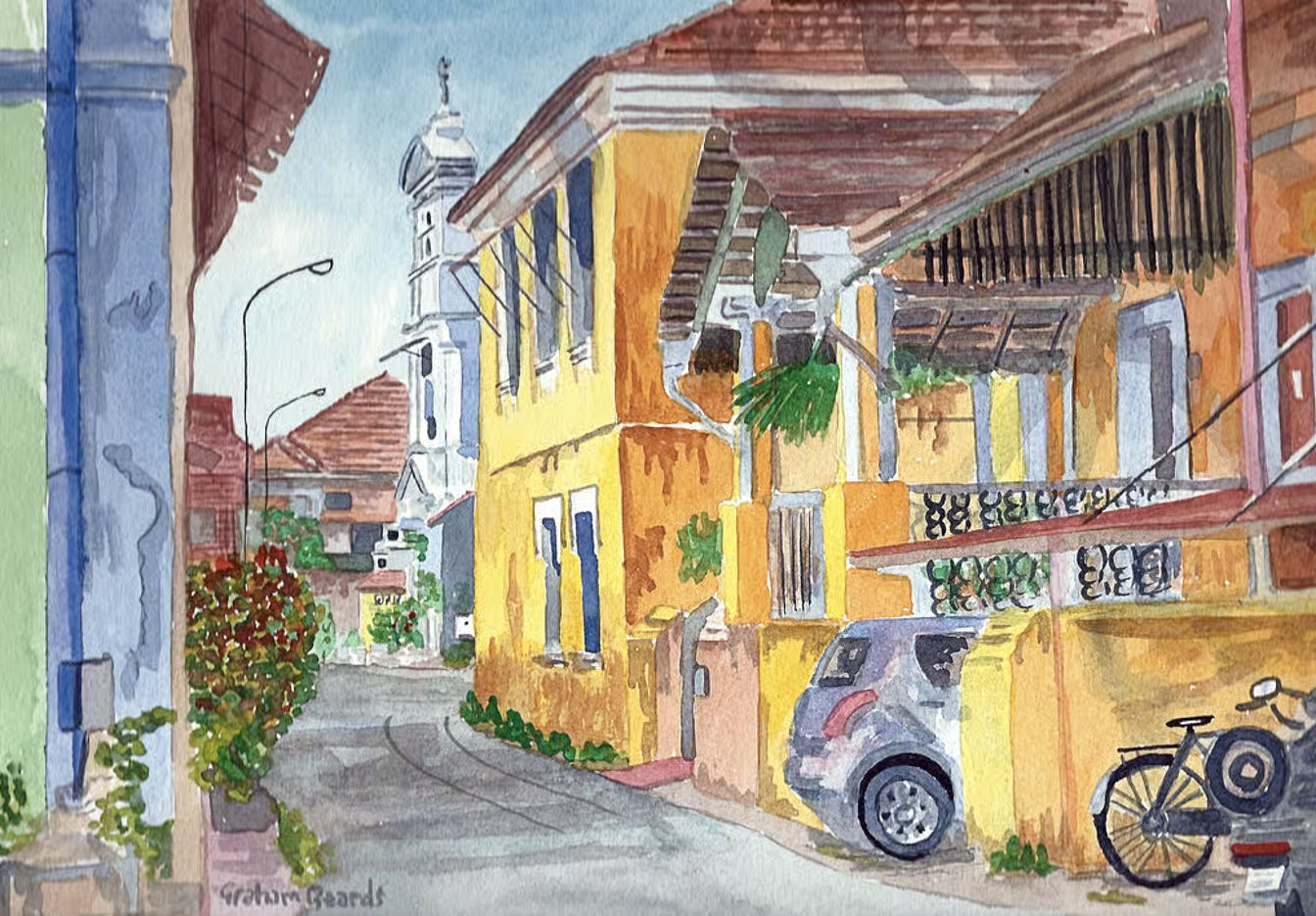
In my part of the world – Goa, India, the last decade has dealt us a culture shift like never before. It's had its benefits, but we've lost a lot as well. One particularly tragic victim has been a dearly held norm for generations – the afternoon nap.

As a child, I remember walking through Panjim in the afternoon. From 1PM to 4PM, the streets were empty. Shutters down, not a patrão in sight. They were all home, enjoying their own versions of the 'sussegad' life, which usually comprised of fish-curry-rice followed by a nap and then some tea. At 4PM, they'd be rolling up shutters again.

The system worked because it was the norm. Everybody did it collectively, so nobody suffered.

At some point though, things changed.

As people from other cultures started businesses in Goa, nap time lost its sacredness. Although only few migrant owned shops stayed open in the afternoon, customer expectations changed. Keeping your shop shut meant losing business to those that were open. And so, Goans adapted. We lost sleep over our competition.

But nobody won.

It reminded me of a passage from Meditations on Moloch by Slate Star Codex:

"From a god's-eye-view, the best solution is world peace and no country having an army at all. From within the system, no country can unilaterally enforce that, so their best option is to keep on throwing their money into missiles that lie in silos unused."

For us Goans, there is no going back. The army must be maintained. Coordinated naps have been lost forever.